Enduring Gaza's Humanitarian Crisis: Families Fight for Survival Amidst Relentless Displacement
The Gaza Strip, a densely populated enclave nestled along the Mediterranean coast, has become a haunting testament to the anguish of war. As the conflict between Israel and Hamas rages on, the humanitarian crisis in this region has reached a breaking point, leaving thousands of Palestinians displaced, desperate, and struggling to meet even their most basic needs.Enduring Gaza's Humanitarian Crisis: Families Fight for Survival Amidst Relentless DisplacementAmidst the deafening roar of the conflict, the cries of young girls and the desperation of their families fill the air in the tent camps of Deir al-Balah, southern Gaza. The relentless cycle of evacuation orders has forced thousands of Palestinians to seek refuge in these makeshift havens, where the scarcity of food and water has become a daily struggle for survival.
The Unfolding Humanitarian Disaster
The situation in the Deir al-Balah beachfront camp is a microcosm of the wider humanitarian crisis unfolding across Gaza. As the Israeli military's evacuation orders have proliferated, at least 84% of the territory now falls within the designated "humanitarian zone," according to the United Nations. This has led to a cascading effect, with an estimated 90% of Gaza's 2.1 million residents being displaced over the course of the war.
The Struggle for Sustenance
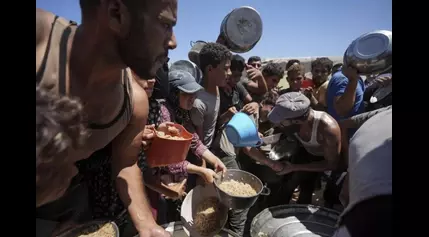
The influx of displaced families has strained the already limited resources available in the camp. Young girls jostle and elbow their way through the crowds, desperate to reach the front of the food line, while boys wait for hours to fill containers with scarce water. Despite the efforts of aid workers, the supply of food and water is dwindling, leaving many to question the source of their next meal or drink.
Desperation and Despair
The growing desperation is palpable, with some displaced Palestinians, like Adham Hijazi, contemplating the unthinkable: "I have started thinking that if there is no food, I will go and drink seawater to endure it. I am talking seriously. I will drink water and salt." The anguish of families like Hijazi's is further compounded by the knowledge that they have already been displaced multiple times, each evacuation order pushing them deeper into a cycle of uncertainty and hopelessness.
The Impact of Shrinking Humanitarian Zones
The Israeli military's strategy of shrinking the designated "humanitarian zone" has exacerbated the crisis, as it has forced the relocation of Palestinians even within the established safe areas. Satellite imagery reveals the stark impact, with tent camps along the coast growing more densely packed and encroaching closer to the sea as the zones are repeatedly reduced.
The Toll on Water and Health
The evacuation orders have had a devastating impact on the already fragile water supply in Deir al-Balah, with the U.N. reporting a decrease of at least 70% since the recent wave of displacement. This has led to the outbreak of skin diseases and other health issues, including the confirmation of Gaza's first case of polio in a 10-month-old baby, who is now paralyzed in the lower left leg.
The Challenges for Aid Groups
As the humanitarian crisis deepens, aid organizations have found it increasingly difficult to provide relief. The U.N. World Food Program, for instance, has lost access to its warehouse in central Deir al-Balah due to a recent evacuation order, further limiting its ability to distribute much-needed resources to the displaced families.Amid the chaos and despair, the people of Gaza cling to hope, praying for an end to the conflict and the restoration of their basic rights to food, water, and security. As the world watches, the urgent need for a sustainable ceasefire agreement and comprehensive humanitarian assistance has never been more pressing.